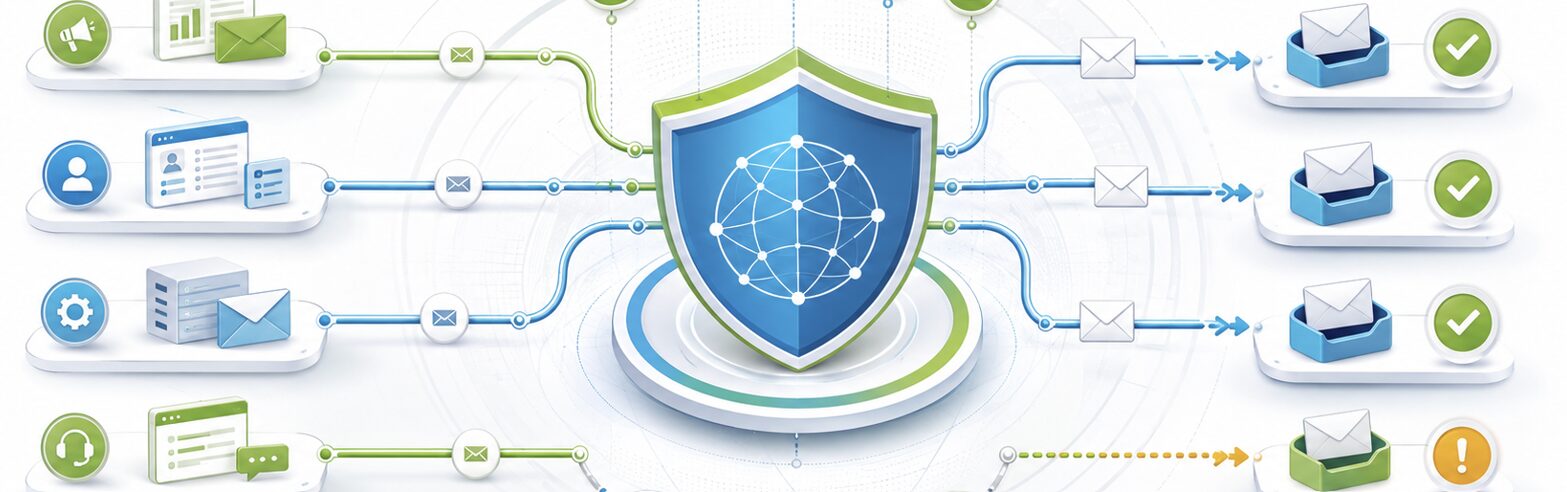
For two years now, the bulk sender requirements from Google and Yahoo have been quietly reshaping who gets to land in the inbox. Microsoft fell in line in 2025. And as of mid-2026, the rules are evolving again — with DMARC parameter changes and new plain-language reporting inside Google Postmaster Tools.
Most experienced email teams glanced at the original requirements and checked the boxes: authentication, low spam rate, one-click unsubscribe. Done. But if you run marketing operations for a B2B company, the box-checking framing is exactly what gets you in trouble. These requirements don’t live in the email channel. They live at the domain level — which makes them an operations and governance issue first, and an email issue second.
Here’s how we’re thinking about it at RightWave.
What’s actually required (the short version)
The three mailbox providers have converged on roughly the same baseline for anyone sending around 5,000 messages a day or more to their consumer inboxes:
- Authenticate everything. SPF, DKIM, and DMARC all have to be in place. SPF says which servers are allowed to send for your domain, DKIM signs the message so it can’t be tampered with in transit, and DMARC tells receivers what to do when a message fails — plus it reports back to you.
- Keep your spam complaints low. Google’s guidance is to stay under 0.10% reported spam and never let it touch 0.30%. Unlike authentication, this one is partly out of your hands — it reflects whether recipients actually want what you’re sending.
- Make unsubscribing trivial. One-click unsubscribe, honored promptly. If you’re still resisting this, it’s a signal your program is optimizing for volume over relevance.
None of this is exotic. The trap is assuming it’s a marketing checklist.
Why this is an operations problem
The requirements apply to every email sent from the domain — not just the campaigns flowing through your marketing automation platform. That includes your SDRs and BDRs running cold outbound through Salesloft, Outreach, or whatever sequencing tool sits next to your CRM. Armed with AI assistants and sending tools, those teams can generate enormous volume fast, and they usually don’t report into marketing and have never thought about DKIM in their lives.
So you end up with a structural conflict: marketing typically owns email authentication, but sales is generating a large share of the sending volume under the same domain. If their list hygiene is loose and their complaint rate climbs, your nurture, lifecycle, and transactional mail pay the price too. One team’s behavior degrades the shared asset.
That’s a governance question, and it’s the one most teams haven’t formally answered:
- Who owns the sending domain and the DNS records behind it?
- Which sending systems are authenticated against it, and do you have a complete inventory?
- Who watches the deliverability signals across all of them — not just the campaigns you can see in your ESP?
- What’s the standard for list hygiene and bounce handling that applies to everyone sending under the domain?
Authentication lives in DNS, and a careless change there can break sending across the entire organization. That alone is reason for marketing ops to sit at the center of this, advising whoever administers the records rather than leaving it to chance.
The B2B exemption is real — and it’s a trap
There’s a genuine carve-out worth knowing: the requirements apply to personal consumer inboxes, not to Google Workspace business accounts. If you’re sending purely to business addresses hosted on Google, those specific rules don’t bind you.
Don’t relax. A few reasons that exemption gives a false sense of safety:
- Your list isn’t clean. Almost no B2B list is exclusively Workspace-hosted business addresses. Prospects sign up with personal Gmail, and plenty of small businesses run on consumer-grade mail.
- Yahoo and Microsoft sit behind a lot of “business” mail. Yahoo manages email for a long list of consumer ISP domains, and Microsoft’s rules cover Outlook, Hotmail, and Live. Those addresses show up in B2B databases constantly.
- The “requirements” are just good practice. Authentication, low complaint rates, and easy opt-out aren’t compliance hoops — they’re what protects your reputation regardless of who you’re emailing.
Treating the exemption as a reason to skip the work is optimizing for the wrong outcome.
What changed in 2026
Two updates are worth putting on your roadmap this quarter:
DMARC parameter changes. The spec introduced new tags — including np for non-existent subdomain policy and psd for public suffix domains — while deprecating older ones like pct and ri. The np tag matters most: it closes a gap attackers use to spoof subdomains that don’t exist. The headline shift is that the primary policy tag (p) is now recommended rather than strictly mandatory, which means your DMARC record deserves a fresh review rather than a set-and-forget.
Deliverability analysis in Google Postmaster Tools. Postmaster has long shown the technical signals — spam rate, reputation, authentication, errors. Now it layers plain-language feedback and recommendations on top of that data, so the people reading it don’t have to be deliverability specialists to act on it. For lean ops teams, that’s a meaningful lowering of the barrier to monitoring this properly.
What we’d actually do
If you want a practical starting point:
- Inventory every sending system tied to your domain — MAP, CRM/sales engagement, transactional, support — and confirm each is authenticated.
- Set up cross-functional governance between marketing and sales on domain reputation. This is a partnership, not a turf war; the domain is a shared asset and should be governed like one.
- Monitor deliverability as an ongoing discipline, not an annual audit. Use Postmaster’s new analysis and Yahoo’s complaint feedback loop to catch problems before they compound.
- Tighten list hygiene and engagement standards. Move non-engagers into slow warm-up tracks, build engagement-based automations, and stop equating list size with reach.
- Stop treating email as a silo. A multichannel approach — ABM across ads, social, and email — both protects your domain and gives you a clearer read on what’s actually moving revenue.
The teams that handle this well won’t be the ones who checked three boxes in 2024. They’ll be the ones who treated their sending domain like the shared revenue infrastructure it is — and built the operational discipline to protect it.
RightWave helps B2B teams turn marketing operations into a competitive advantage — from deliverability and data hygiene to the cross-functional plumbing that makes campaigns actually work.
Reference – https://martech.org/new-rules-for-bulk-email-senders-from-google-yahoo-what-you-need-to-know/