Most marketing operations teams will tell you that list uploads are a “small task.”
A field marketer drops a spreadsheet into a ticket. Campaign ops opens it, cleans the columns, fixes the company names, fills in the gaps, builds the Marketo program, creates the Salesforce campaign, runs the import, checks the errors, and tells the requester it’s done.
It looks like five minutes of work. In reality, it’s where attribution quietly breaks.
Every inconsistent country value, missing email, mistyped company name, or unmapped job title that slips through at the import stage shows up later as a segmentation gap, a routing failure, a scoring miss, or a hole in the campaign report. The list got uploaded. The damage was done upstream.
At RightWave, we recently rebuilt this workflow for a B2B client using monday.com, Zapier, RDN, Marketo, Salesforce, and Clay. The use case will feel familiar to anyone running campaign ops at scale.
The Client’s Starting Point
The client’s marketing team was receiving list upload requests from every direction — field marketing, partner marketing, events, sales, campaign managers. Requests were tracked in monday.com, but execution was still almost entirely manual: download the file, review it, clean it, sometimes enrich it, build or update the Marketo program, create or map the Salesforce campaign, import, debug, notify.
The problem wasn’t really the effort. It was the variability. Every list arrived in a slightly different shape. Job titles were inconsistent. Country values didn’t match the CRM taxonomy. Email fields were patchy. Even when an import “succeeded,” the downstream cost was visible — in segmentation, in routing, in attribution, and in reporting nobody fully trusted.
That’s where we came in.
What We Built
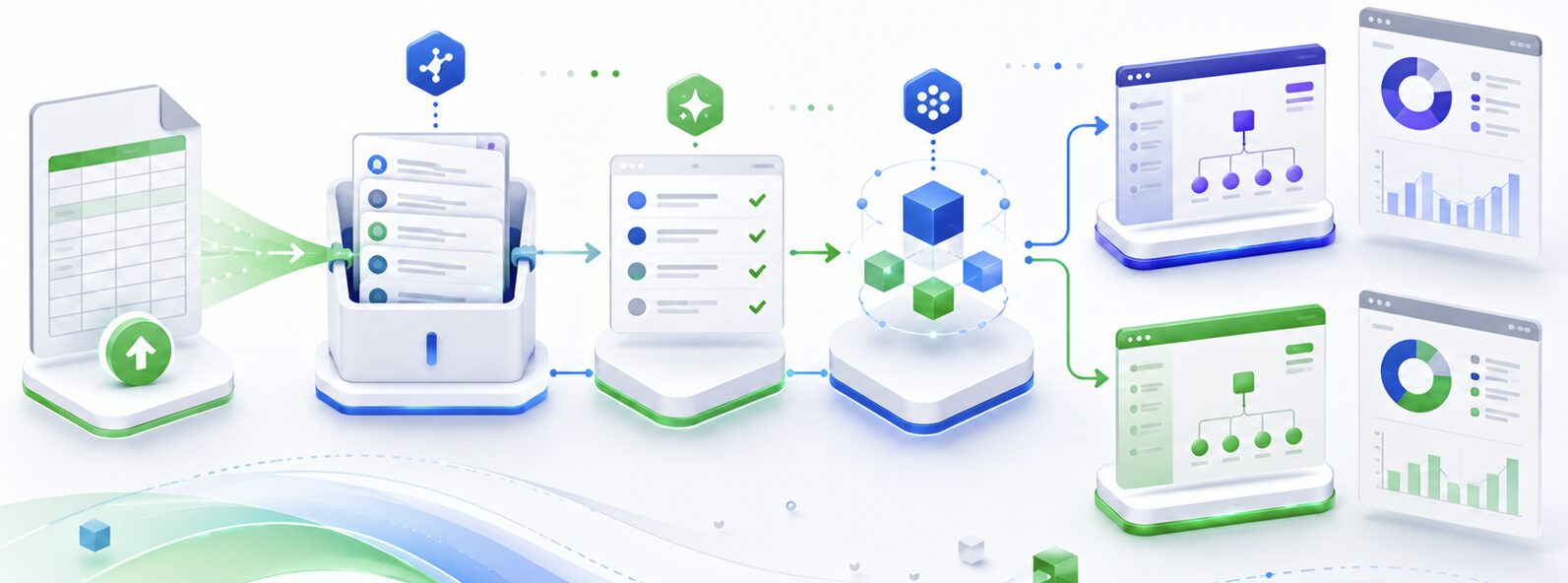
The new workflow turns a list upload request logged in monday.com into a structured, governed campaign ops flow. monday.com is the intake layer. Zapier orchestrates the steps across systems. RDN cleans and normalizes the data. Clay handles enrichment. Marketo and Salesforce receive data that is already campaign-ready.
The flow, at a high level:
- A user logs a list import request in monday.com.
- Zapier picks up the request and routes the file and its metadata into RDN.
- RDN standardizes the list against the client’s agreed field rules and CRM/MAP taxonomy.
- Clay enriches missing fields — emails, company data, role and seniority — where required.
- The cleaned list is prepared for Marketo program or static list import.
- The corresponding Salesforce campaign is created or mapped, with campaign member status applied.
- Status updates and exceptions flow back into monday.com so ops has visibility into what landed, what was rejected, and what needs review.
This wasn’t a one-off automation. It was designed as a controlled operating process.
Why RDN Sits at the Center
Most automation projects fail because teams try to move messy data faster. That just makes the mess scale.
We placed RDN — RightWave’s data normalization layer — between intake and execution. Before any record reaches Marketo or Salesforce, it has to pass through cleaning and standardization: required field validation, email format checks, company name normalization, country and region standardization, job title cleanup, industry and segment mapping, duplicate handling, and Marketo/Salesforce field compatibility. Records that can’t be processed are flagged for review rather than silently dropped.
This is the difference between task automation and campaign ops automation. Task automation moves data from one system to another. Campaign ops automation makes sure that data is usable, reportable, and aligned to the systems that actually drive revenue.
The Marketo and Salesforce Layer
Once a list is clean, Marketo and Salesforce can’t be treated as separate execution steps. They have to be designed as one connected campaign data flow — otherwise attribution breaks before the campaign even launches.
Marketo supports bulk lead imports via its REST API, including asynchronous program member imports with defined member statuses and email as the deduplication key. Salesforce represents marketing initiatives as Campaigns, with Campaign Members linking those campaigns to Leads or Contacts. Our workflow thinks about both together: is the Marketo program or static list ready? Does the Salesforce campaign exist, or does it need to be created? Are members landing in the right status? Is attribution preserved from the moment of import?
This is the layer where most campaign ops workflows quietly fall apart. Getting names into Marketo is easy. Getting names into Marketo with the right program, status, and campaign association so reporting works three months later is the part that takes design.
Where Clay Fits In
Not every list arrives complete. Event lists are notoriously patchy. Partner lists often lack work emails. Sales-handed lists sometimes have a name and a company and nothing else useful.
Clay is the enrichment layer. Its Work Email waterfall runs across multiple providers in sequence and stops at the first valid result, and its webhook support lets us push records in and pull enriched data back out as part of the flow. In this setup, Clay fills in missing emails, validates work addresses, enriches company-level data, and adds role and seniority where the source list left them blank — before the record ever reaches Marketo.
The result is that lists from inconsistent sources can still meet a consistent quality bar by the time they hit the MAP.
Zapier Is the Glue, Not the Strategy
Zapier connects monday.com, RDN, Clay, Marketo, Salesforce, and the workflow notifications. It triggers steps, passes payloads, runs conditional logic via paths and filters, and routes failures into alternate flows.
But the value isn’t Zapier itself. The value is in what gets designed around it: what happens when a list is malformed, when required fields are missing, when RDN rejects records, when a Marketo import fails, when a Salesforce campaign already exists, when Clay can’t find a valid email. Campaign ops can’t run on blind automation. It runs on automation with exception handling baked in.
That’s what makes Zapier useful here. Not as a magic connector, but as the orchestration layer for a workflow that knows what to do when things don’t go to plan.
What Actually Changed for the Client
The client moved from a manual, fragmented list upload process to a structured one. The impact showed up in four places.
Campaign readiness got faster. Ops stopped touching every list end-to-end and started focusing on exceptions. Routine imports moved on their own.
Data got cleaner before import, not after. RDN catches problems upstream, which means segmentation, routing, and scoring downstream actually behave the way the team expects.
Attribution held up. Because Marketo program structure and Salesforce campaign creation are connected at the point of import, campaign context is preserved from the start — instead of being reconstructed later at the reporting stage, which is where most attribution problems originate.
The workflow became extensible. Today it handles list import and cleaning. The next phase deepens Clay enrichment, automates program creation, automates Salesforce campaign creation, and adds AI-assisted email enrichment. The same operating pattern can be applied to webinar ops, event follow-up, nurture, partner campaigns, and ABM plays.
The Bigger Lesson: AI-Ready Ops Starts With Workflow Discipline
A lot of marketing teams are currently bolting AI onto operations and hoping it fixes things. It won’t.
If your intake is inconsistent, your data is messy, your naming conventions are loose, and your MAP and CRM aren’t talking to each other properly, AI will only make the mess move faster. Before marketing ops can become AI-enabled, it has to become workflow-enabled — clear intake, clean data rules, standardized campaign structures, defined exception handling, connected MAP and CRM processes, and human review where judgment is actually required.
That’s the foundation that makes AI useful in campaign operations. Not as a chatbot sitting on top of broken systems, but as part of a controlled operating model where data, workflow, and execution are designed to work together.
RightWave’s Take
Campaign ops isn’t really about building emails, creating programs, and importing lists anymore. It’s about designing repeatable operating systems for marketing execution — intake, automation, normalization, MAP/CRM alignment, governance, QA, enrichment, and AI-readiness as a connected whole.
For this client, the list upload workflow was a starting point. The real opportunity is much larger: once the intake-to-import flow is automated and governed, the same pattern extends across the rest of the campaign ops surface area.
That’s the actual promise of automation in marketing operations. Not doing the same work faster. Building a cleaner system to do it in.