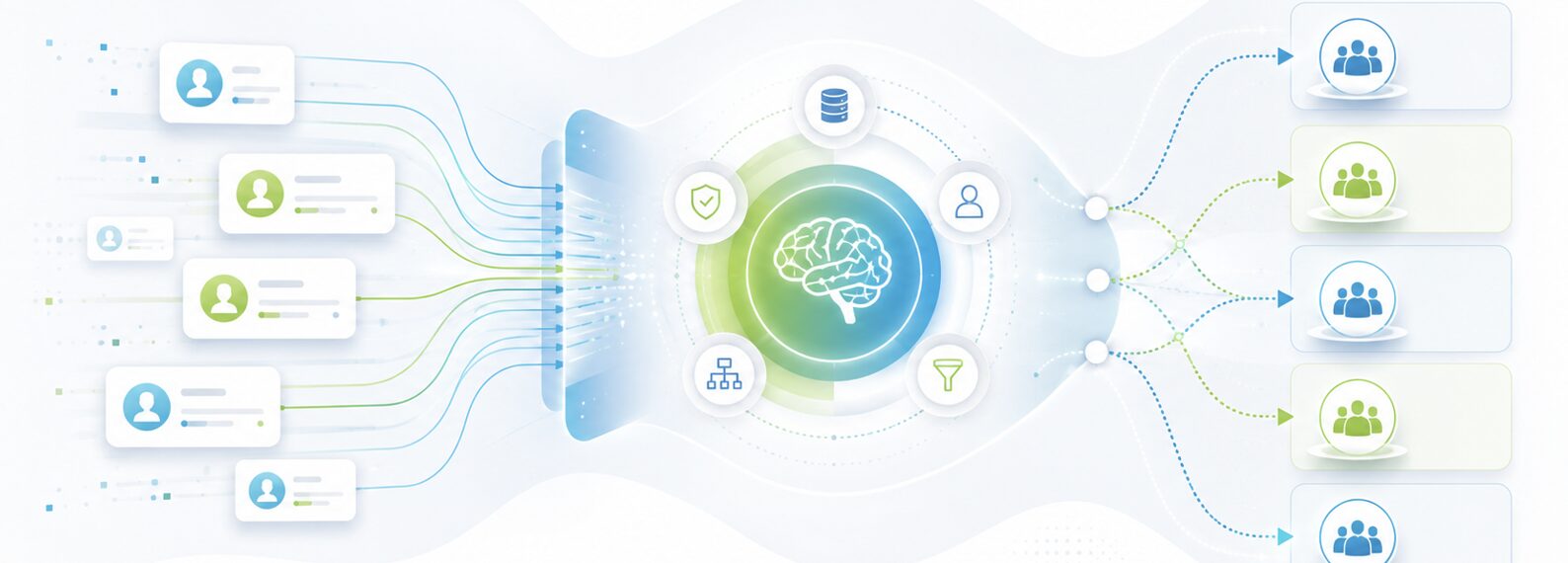
A B2B client was paying roughly $60,000 a year for a dedicated lead routing platform. The tool worked. The logic was sound. Territories were mapped, rules were tested, and leads were landing where they should.
That was exactly the problem.
When a system becomes that stable, you have to ask a harder question: do you still need the tool, or do you just need the logic? For this client, the answer saved them sixty thousand dollars a year — and gave them something more valuable than the savings.
Routing looks simple. It almost never is.
From the outside, lead routing is a one-liner. A lead comes in, it gets assigned, sales follows up.
Anyone who has actually maintained the routing layer inside Salesforce, Marketo, HubSpot, or a dedicated RevOps platform knows better. Real routing logic is a layered mess of territory rules, account ownership, region and country mapping, company-size thresholds, product interest, lead source paths, partner overlays, named-account exceptions, round-robin pools, fallback queues, and one-off carve-outs that someone added in 2021 and nobody wants to touch. When the underlying data is messy — and it usually is — even the most capable routing tool will confidently send leads to the wrong place.
This matters because routing isn’t an admin task; it’s a speed-to-revenue task. The well-cited MIT/InsideSales response study found that the odds of contacting a lead within five minutes versus thirty are roughly 100x higher, and the odds of qualifying that lead are 21x higher. Routing is what stands between an inbound lead and that five-minute window. So the real question isn’t “who owns this lead?” It’s “how do we get a qualified prospect to the right person fast enough to matter?”
The client situation
Our client had built a thoughtful routing model on Fullcast — a capable RevOps platform that handles territory-based assignment and pushes ownership updates into Salesforce. The rules were good. The model worked.
But over a couple of years of working alongside this client on data quality, campaign operations, Marketo and Salesforce workflows, and automation, we had absorbed every rule, every exception, and every fallback path. We knew which fields mattered, which territories had carve-outs, which leads needed enrichment before they could be assigned, and which records belonged in a review queue instead of a rep’s inbox. The routing model wasn’t a black box to us — it was a documented, repeatable system that happened to live inside a tool the client was paying for.
So we asked the obvious question: could we move the routing intelligence into RDN, preserve accuracy, and retire the standalone tool? We could.
Routing intelligence starts with the data, not the rules
The mistake most teams make is treating routing as a rules problem. It’s not. It’s a data problem with a rules layer on top.
If “United States,” “USA,” and “US” are sitting in the same country field, your territory rules will misfire. If company names don’t match existing accounts, your account-based routing will hand a known customer’s expansion lead to a brand-new SDR. If email domains don’t resolve cleanly, your enrichment-dependent rules collapse. Forrester has made this point for years: B2B data quality isn’t a one-time cleanup project, it’s a process and governance problem.
So we didn’t start with rules. We started with normalization. Before any lead reached the routing logic, RDN standardized the inputs — country and region values, company identifiers, industry classifications, email domains — and deduplicated against existing records. Only then did the routing layer get to make a decision.
The decision layer
With clean inputs, the routing logic itself became straightforward. RDN ran each lead through the same hierarchy the client had built in Fullcast: match the lead to an existing account if one exists (in B2B, this is almost always the most important question — far more important than picking a rep); if matched, route to the existing owner; if not, apply territory and segment rules; handle named accounts and product-line exceptions; fall through to round-robin pools where appropriate; and send to a fallback queue when no rule fits.
The change wasn’t in the logic. The change was in what surrounded it. Every routing outcome came with a decision trail: which rule fired, what data was used, whether enrichment was applied, why a particular owner was chosen. When a rep questioned an assignment — and reps always do — there was an answer.
Exceptions get surfaced, not buried
In most routing systems, bad data still moves forward. A lead with a missing country field gets routed to a default queue. A lead with an unrecognized company name gets handed to whoever happens to be next in the round-robin. The system doesn’t fail loudly; it fails quietly, and you find out weeks later when an AE complains about junk in their pipeline.
We built exception paths into the workflow on purpose. Leads with low routing confidence get held for enrichment, sent to a review queue, flagged for missing fields, or escalated to the ops team. The system either routes correctly or makes the problem visible. Silent failure isn’t an option.
What actually changed
The headline outcome is the $60,000 in annual tool spend the client could now reclaim. That’s the number the CFO cares about, and it’s real.
But the operational outcome mattered more. The routing logic was no longer sitting in a separate platform the team had to context-switch into. It was part of the same operations layer where data quality work, campaign workflows, and Salesforce-Marketo integrations already lived. One team, one system, one place to change a rule. Cleaner inputs, more transparent decisions, easier troubleshooting — and a foundation that could absorb whatever came next, including AI-assisted decisioning.
A quick note on AI
There’s a lot of energy right now around using AI to enrich leads, score prospects, summarize accounts, and trigger workflows. That’s all useful. But none of it works if the operational foundation underneath is brittle. If the data is inconsistent, AI just makes faster mistakes. If the routing logic isn’t documented, AI can’t improve it safely. If there’s no audit trail, no one trusts the output.
Lead routing is one of the clearest examples of why the boring work — normalization, governance, exception handling — has to come before the interesting work.
The bigger point
Lead routing isn’t a one-time Salesforce config, and it shouldn’t be a permanent dependency on a specialized tool. It’s a living workflow that changes as your territories, teams, products, and data sources change. The companies that get this right are the ones who can adapt the logic quickly without losing control of it.
For this client, that meant turning routing from a tool-dependent workflow into something they actually owned — cleaner, more explainable, and considerably cheaper. Faster routing matters. Smarter, governed, explainable routing matters more.