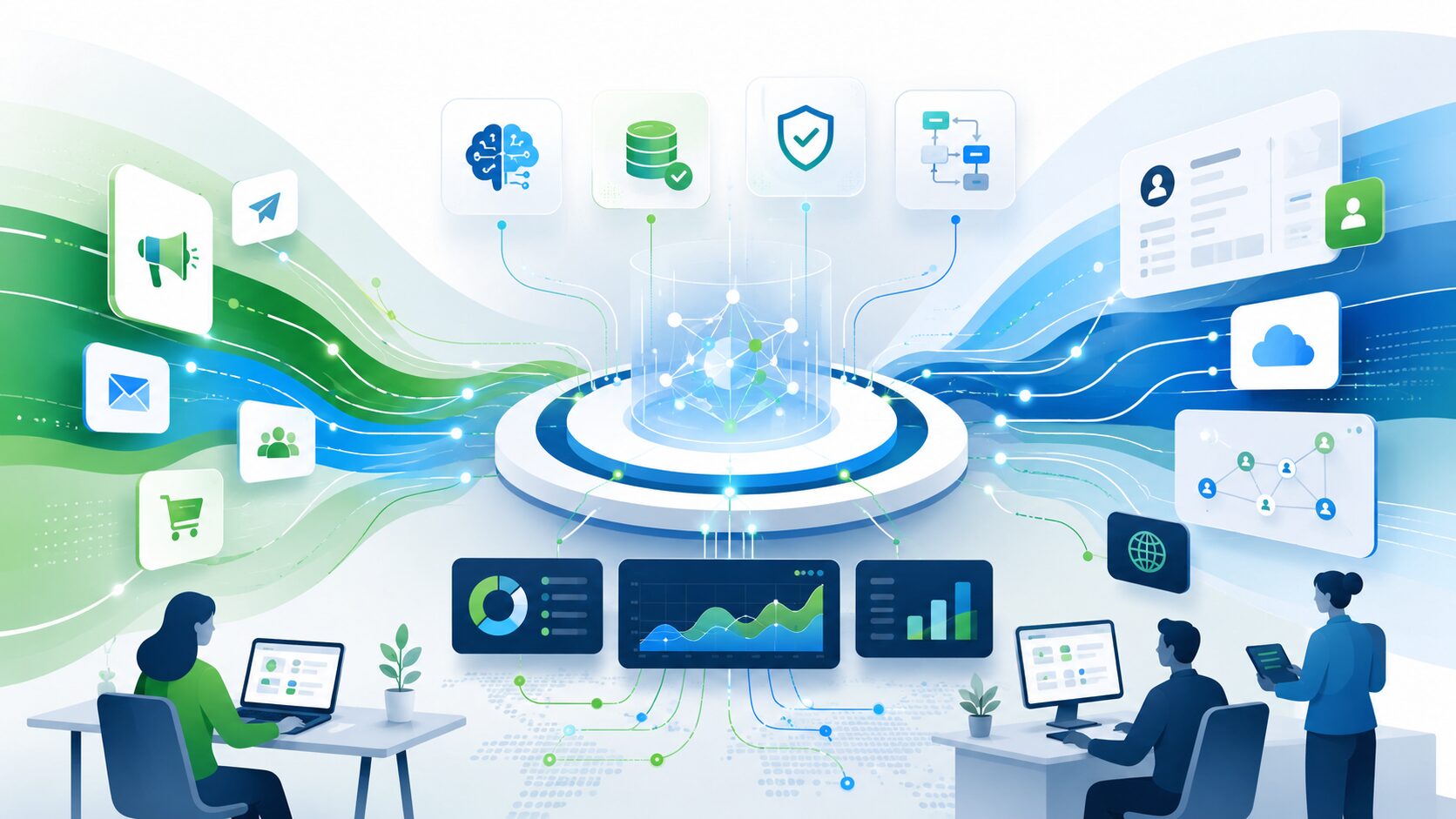
For years, Marketing Operations support meant one thing: campaign execution.
Build the emails. Create the landing pages. Clean the lists. Fix the forms. Keep Marketo, HubSpot, or Salesforce running without breaking anything.
That work still matters — more than ever, actually. But the role of MOps has grown way beyond getting campaigns out the door. And the support model around it needs to grow too.
MOps teams are carrying more than ever
Talk to any MOps professional and you’ll hear the same thing: they’re not short on work. They’re short on time, bandwidth, clean data, and the right kind of help.
A typical team is juggling campaign builds, platform admin, data governance, lead scoring, attribution headaches, integrations, QA, and a constant stream of requests from sales, demand gen, and leadership.
And now there’s a new layer on top: “Can we use AI to do this faster?”
Fair question. But here’s the uncomfortable truth: AI doesn’t fix broken Marketing Operations. It exposes them.
If your data is messy, your routing rules are unclear, and your naming conventions are ignored, AI won’t magically clean things up. It’ll just create more confusion, faster.
That’s why MOps support can’t just be task execution anymore. It has to include process thinking, data discipline, QA, and genuine AI readiness.
A good agency extends your team — it doesn’t replace it
Let’s address the awkward question head-on: agency vs. in-house?
Wrong framing. It’s not either/or.
Strong in-house teams are essential. They know the business, the stakeholders, the politics. No outside partner can replicate that.
But even great internal teams need leverage — reliable execution support, specialized skills that don’t justify a full-time hire, backup during campaign spikes, and people who’ve seen the same problems across dozens of stacks and can spot what’s slowing you down.
Often, the real value isn’t in doing the work. It’s in noticing things: Why do campaign requests take so long? Why is sales complaining about lead follow-up? Why doesn’t anyone trust the reports? Why is AI adoption stalling despite all the leadership enthusiasm?
Those are operational questions. And they directly affect marketing performance.
The biggest value is often what doesn’t happen
When people measure MOps support, they count output — campaigns built, emails launched, pages created.
But a lot of the value is in what gets prevented: bad data entering the system, broken links going live, wrong segmentation, duplicate records, and AI-generated mistakes slipping into live workflows.
QA, governance, and documentation aren’t glamorous. But in MOps, small mistakes create big downstream problems. One wrong sync rule can mess up sales follow-up, attribution, and leadership reporting all at once.
That’s the work that protects the revenue engine.
Why one inclusive retainer beats a menu of line items
Here’s a practical problem with most agency models: everything is a separate line item. Campaign execution is one rate. QA is another. Data support, web support, coordination — all separate.
So teams start asking, “Should we use the agency for this?” instead of just solving the problem.
RightWave’s inclusive retainer works differently. One retainer covers campaign operations, QA, development, data support, web support, project coordination, and a US-based Account Manager.
Why does that matter? Because real MOps work never fits neatly into one box. A campaign issue is often also a data issue. A landing page issue is often a tracking issue. An “AI problem” is usually a data governance problem in disguise.
When everything’s under one roof, the question shifts from “which bucket does this fall into?” to “what’s the best way to solve this?”
AI belongs inside MOps, not beside it
AI can genuinely help — with segmentation, documentation, QA, content variations, repetitive tasks, and platform work. But it shouldn’t be a shiny separate layer bolted onto the side of your operations.
It needs to be embedded in how the work actually happens. That means asking the unglamorous questions first: Is the data clean enough? Are processes documented? Do people know where AI helps and where a human still needs to review?
AI enablement isn’t about tools. It’s about readiness.
Where this is all heading
The underlying need is the same everywhere: make marketing faster, cleaner, more measurable, and more scalable.
Modern MOps teams don’t just need hands. They need thinking partners — people who can build the campaign and ask why the process is slow. Clean the data and fix the governance that let it get dirty.
That’s the direction RightWave is moving in. Campaign execution still matters. But the future of MOps support is bigger than that.
Marketing Operations has changed. The support around it should too.